Paris,7th July
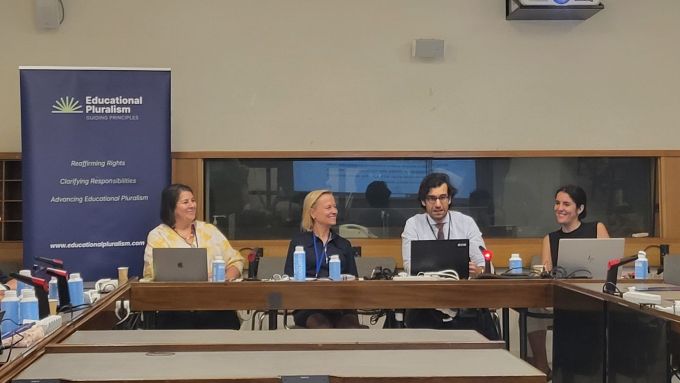
UNESCO Headquarters hosted the Regional Open Consultation for Europe on Educational Pluralism, bringing together representatives of Member States, leading education experts, and civil society organizations to discuss the Guiding Principles on Educational Pluralism.
The consultation, hosted with the support of the Permanent Delegation of Chili to UNESCO, provided an important platform for the exchange of perspectives on advancing educational pluralism across Europe.
Representatives from numerous Permanent Delegations to UNESCO participated in the consultation, including those of Chili, Spain, Paraguay, Germany, Libya, Indonesia, Nigeria, Andorra, Cyprus, and Russia, reflecting the growing international interest in in this initiative.
The event featured contributions from internationally recognized experts, including Kishore Singh, former United Nations Special Rapporteur on the Right to Education; Georges Haddad, former Director of UNESCO's Education Research and Foresight Unit and former President of Sorbonne University; and Mounme Rolla, representing UNESCO.
The consultation also welcomed representatives from civil society and international education networks, including, among others, Montessori, Global Schools Forum, Global Protestant Education Network and Waldorf-Steiner organizations, whose contributions enriched the discussions with a wide range of educational perspectives.
One of the themes addressed during the consultation was the role of families, including the extended family, and the community in the children's educational process. Participants highlighted the importance of its recognition, respect and contribution within educational systems.
The consultation also explored how educational values and views are reflected in the educational practice. Therefore, choices regarding educational tools—such as the use of new technologies or artificial intelligence—along with curriculum content, pedagogical approaches, and the importance given to nature or international engagement, all reflect the values and educational philosophy of an institution.
A particularly important discussion focused on the role of the State in education and its obligations, scope of action and limits in guaranteeing the right to education. The debate underscored the importance of the existence of a continued and dynamic dialogue between the State, the families, the communities and the educational institutions, in order to both uphold public interest and protect educational freedom.
The insights gathered during the Regional Open Consultation will contribute to the next draft of the Guiding Principles on Educational Pluralism. The consultation process will continue with upcoming Regional Open Consultations in Buenos Aires (Argentina), and Johannesburg (South Africa)
Through these regional consultations, the Educational Pluralism initiative aims to develop a set of Guiding Principles that reflects the perspectives of governments, international organizations, experts, and civil society, fostering more pluralistic education systems worldwide.